
NATHAL Projects and Daily Examples
The following examples - big and small - are real-life applications from NATHAL trainees, who expedited their projects, daily work, or personal challenges:
- Microbiology
- Forest Treatment
- Olive Plantation
- University Career
- Exam Preparation
- Technical Service
- Desaster Control
Microbiology and the New Scientific Paradigm
(Excerpt from the German article “Science in the 21st Century” in Comed 12/1999 by Dr. Matthias Kleespieß – translated and shortened by AI)
Since 1990, Prof. Gertje Lathan has been teaching the NATHAL® method, a highly reproducible way to contact the “world spirit” (or simply “God”) anywhere and to extract completely new information from this source. Here the extraordinary power of this method for scientific research is shown, focusing on the achievements of Dr. Philippe Lathan, who after completing her training can at any time, in full waking consciousness, retrieve any desired and permissible information from the highest spiritual source.
Three years ago, I filed a patent for a discovery whose full scope is only now becoming visible: water kefir, a close relative of milk kefir, forms a polymer that had never before been technically used worldwide. This invention opens up an entirely new bio-raw material with applications such as eco cat litter, bioplastics, ecological insulation, paper substitutes, and innovative dressing materials, all of which, however, face high price pressure. The scientific task seemed simple but proved extremely difficult with conventional methods: water kefir originally needs sugar and figs, which would make industrial production far too expensive, so cheap substitutes for figs had to be found.
Because the patent is based on the first technical use of this polymer, there was no scientific or technical literature to consult, so as microbiologist I faced a “black box” situation. For two years, I tried all possible low-cost replacement substances, but after at most five successive transfers with each substrate, growth and polymer production broke down. The usual empirical approach would have required countless trials, complex chromatographic fractionation of fig components, combinatorial testing of fractions and single substances, and then literature-based searches for cheaper plants containing the active compounds - a process likely taking three to five years and at least 5 million EUR, with success uncertain.
This illustrates the central weakness of today’s paradigm: research is purely empirical and therefore extremely slow and expensive in truly new fields, so real innovations are almost systemically reserved for large corporations. In radical contrast, the development guided and initiated by Philippe Lathan progressed at a pace for which “sensational” is a weak word: in only eight weeks, with just one experimental worker (myself) and no more than 30 minutes of consultation per day, the desired substitute substrate was identified, the yield increased by more than 25%, the doubling time shortened, and raw material costs reduced by nearly a factor of 20.
Lathan, a philosopher by education, is in permanent contact with the highest spiritual sources and serves as a mediator between worlds, enabling the use of supra-personal knowledge. He does not rely on his own experience; research can proceed almost without empirical groping, drawing on a source that already knows everything. His recommendations always hit the mark: each proposed set of experiments contained at least one variant that achieved the targeted result - faster growth, higher yield, or both - so that empiricism was reduced to a minimal confirming role.
Especially striking was his ability to explain an observed decline in kefir growth with a cause completely outside of my previous considerations, along with an unconventional solution that immediately restored vigorous growth. Normal scientific work can only test a limited spectrum of parameters; many boundary conditions must be ignored, and these may hide the most positive surprises. Lathan excludes nothing a priori and can therefore transmit recommendations that seem unusual or even senseless by ordinary standards but turn out to be highly effective.
His advice also showed that the sequence of individual steps is crucial so that the kefir culture can gradually adapt; a “final” recommendation given too early would have failed. In parallel, his indications respected my own personal development, so my initial inner resistance gave way to growing trust, creativity, and intuition, so that a harmonious and highly effective team emerged. I as a scientist was never excluded, since Lathan’s answers always arose in dialogue and depended on asking the right questions.
After this pilot project, the conclusion is clear: inductive science in this new sense - drawing systematically on the highest spiritual sources and only minimally on blind empiricism - is in every respect superior to conventional methods. Its triumph, in my opinion, will no longer be stoppable and will enable and accelerate any conceivable technical and scientific development.

Forest Treatment Study
(undisclosed study report, shortened and translated by AI)
Overview
This study was conducted by a private research association (Association for Medical and Ecological System Research e.V., Frankfurt) on a vegetation and soil ecological comparison between a treated and an untreated spruce forest slope near Winterberg (Hochsauerland, North Rhine-Westphalia) following a single, undisclosed application carried out in April 1987. The aim was to detect potential changes in plant vitality, species composition, and soil conditions within the first growing season.
Study Design
On two adjacent slopes with comparable exposure and light conditions at approximately 650–663 m a.s.l., one area was treated and the other kept as an untreated reference plot. The investigation comprised a floristic survey, soil sampling of A and B horizons, root studies on wavy hair-grass (Deschampsia flexuosa) turfs, and length measurements of one-year-old spruce seedlings along a 140 m diagonal transect.
Vegetation and Species Prevalence
On the untreated plot, vegetation cover was about 70%, dominated by wavy hair-grass, heather (Calluna vulgaris), lingonberry (Vaccinium vitis-idaea), great wood-rush (Luzula sylvatica), white moss (Leucobryum glaucum), and a few 8–10-year-old spruce trees partly showing needle loss and yellowing. The treated area showed roughly 95% cover, substantially higher species richness (including broom, thistle, clover, and orchard grass) as well as pronounced natural regeneration of one-year-old spruce seedlings and vigorous spruce trees exhibiting renewed shoot growth.
Soil Properties
Soil analysis by LUFA Münster (Joseph Koenig Institute) revealed consistently strongly acidic conditions (pH in KCl approx. 3.2–3.7), with very low to low levels of plant-available phosphorus, potassium, and magnesium, indicating nutrient-poor, base-deficient sites. No significant differences in depth, moisture or structure were observed between treated and untreated soils in the auger cores; only the A horizon and the B horizon of the treated plot were qualitatively described as “healthier” and slightly lighter in colour.
Root Development in Spruce Seedlings
An initial pilot analysis of 80 spruce seedlings showed that seedlings from the treated plot had on average 12% longer aboveground shoots and 20.5% longer roots than those from the reference plot. A larger series with 130 seedlings per plot supported the impression of better root development on the treated area, whereas a parallel large-scale experiment on Deschampsia turfs yielded no evaluable difference due to methodological limitations during storage and handling.
Conclusion and Recommendations
Within the first growing season after application, the treated site appears overall more vital than the untreated reference, reflected by higher species diversity, denser ground vegetation, stronger natural spruce regeneration, and a tendency toward better developed root systems despite persistently acidic, nutrient-poor soils. As short-term soil chemical changes (melioration) cannot be clearly demonstrated, it is recommended to apply the treatment to part of the previously species-poor reference area and to monitor both sites over several years to clarify the specific contribution of the treatment relative to other environmental factors.
Olive Plantation
(excerpt from: S. Peter, B. Ibrahim: "Intuitive Innovation: Unconventional Modeling and Systems Neurology", in Mathematics 2024, 12(21), p. 3308)
Mr. Rolando Santini, a Swiss architect of Italian descent, purchased a property near Florence and often sought advice from P. Lathan [co-founder of NATHAL] on personal and professional matters, trusting P. Lathan’s intuitive insights. When Santini decided to convert part of his property into an olive plantation, he asked Lathan for guidance. Lathan recommended an unusual variety of olive trees deemed unsuitable by experts.
Following Lathan’s unconventional advice, Santini planted 480 olive trees not in parallel rows but in a unique pattern: alternating positions across different directions, often over 20 m apart. Understanding how farmers typically worked, Santini wisely stayed during the planting to ensure the farmers followed Lathan’s recommendations, knowing they might have otherwise done it their own way.
Typically, about 20% of olive trees may not thrive after a few years; however, in this case, only 3 out of 480 trees dried out (see Figure 2).
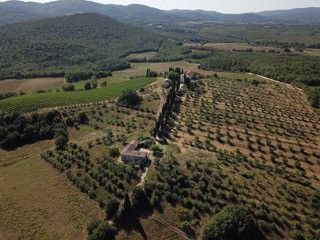
This exceptionally low rate is unusual for farmers, especially since the olive tree variety recommended by Lathan was deemed unsuitable and rejected (from unpublished personal communication with P. Lathan, 2024). After 20 years, Rolando Santini received an Excellence Award for the quality of his olive oil production! [29,30].
Of course, intuitively gained news, such as the one above, whose effectiveness is inexplicable, represents a challenge for corresponding theories and models, but also an opportunity to develop them further.
Career of a University Professor
(Personal account of Dr. habil. Gesine Witt, marine chemist)
In August 1997, I attended the NATHAL® Institute for the first time for the basic course (intensive training). At that time, I had been unemployed for six months and was enrolled in training to become a Heilpraktikerin (natural health practitioner). My professional efforts were proceeding along two tracks. On one hand, I was trying to continue my previous marine research through a DFG (German Research Foundation) project or a habilitation fellowship; on the other, I was fully immersed in my Heilpraktiker training. At that point, I wasn’t sure what the right path for me would be. Due to various subjective obstacles, I was unable to persuade the management of my former research institute to support my fellowship application. However, I did succeed in finding a professor at the University of Rostock who was willing to co-submit my proposed topic as a DFG project.
During the NATHAL® basic course (intensive training), it became repeatedly clear to me that my true calling was research and that I had a deep connection to water. Everything pointed toward marine science continuing to be my vocation, even though, in my current situation, I had no idea how I could actually pursue it without a project or funding. After receiving this message repeatedly, I had a personal conversation with Philippe Evrard-Lathan. He too emphasized that my task was research related to water and that working as a Heilpraktikerin would not fulfill me. We discussed the content of my research topic, which focused primarily on the input of organic pollutants into the Oder estuary and the Baltic Sea. This topic had gained urgency at the time due to the Oder flood. Philippe Evrard-Lathan gave me valuable advice on how to revise my grant application — the influence of the flood as a natural disaster, he said, should be an important aspect.
The next day, during a NATHAL® session, I received the message that I would be granted a habilitation fellowship. Until then, I had always assumed I would have to submit the topic as a project proposal and had no idea how I might still obtain a fellowship. Armed with this “knowledge,” I went home. A week later, I received a phone call from the equal opportunity officer at the institute, who told me that the Ministry of Education still had funds available for supporting habilitation fellowships as part of the women’s advancement program (aimed at increasing the proportion of female university lecturers). The applications then on file were of insufficient quality for funding. In consultation with my university professor, I submitted my revised application, which was approved on December 1, 1997 — the only one to be granted. Since then, I have been working again in marine research.
Because I had applied for jobs in several places, I was also invited to an interview at the Institute of Forensic Medicine and, after the first conversation, was shortlisted. I now faced another career decision: should I continue my habilitation in marine research or take a “job for life” as a forensic toxicologist? Once again, I sought advice from Philippe Evrard-Lathan. He told me that in the long run, I would not enjoy toxicology — the analytical routine would bore me — whereas in marine research he had a good feeling. He predicted that I would achieve results more quickly than I thought and that the collaboration with the new Canadian professor would be very fruitful. Since I also felt that marine research was “my thing,” I decided to follow that path.
As it turned out, Philippe Evrard-Lathan was absolutely right. As soon as I returned to the institute, I was integrated into an EU project — as if they had just been waiting for me. I received all the 1997 samples and accompanying data characterizing land runoff in the Oder estuary area before and after the flood, and I’ve already analyzed them for the pollutants that interest me. The other projects I’ve joined are also proving very promising. At the same time, the DFG proposal continued to move forward, with funding requested for project materials and a position for myself for a third research year. I’m curious to see whether it will be approved — though I already know the answer, since I received a positive message about that as well during a NATHAL® session.
What happened next
My DFG application was also approved, allowing me to continue working for two more years on my habilitation after the fellowship. The topics proved well-suited for developing a solid body of work. Collaboration with my professor was extremely helpful — over the four years, he became a highly valued teacher. In my experimental approach, I followed the intuitive guidance I received during my NATHAL® sessions, which showed me the right research direction. By chance, I met a colleague from Hamburg at an international conference and began collaborating with him on a new project studying the sources of pollutant inputs into the Baltic Sea. This became another research focus for me — one that had already begun to emerge during earlier sessions.
After successfully completing my habilitation, I again reached a turning point: what next? Where did my professional future lie, and how could I support myself and my daughter financially? Having separated from my husband in the meantime, finding continued employment had become an existential issue. Gaining a professorship quickly was unrealistic, given the long appointment processes in Germany — nearly a year.
One possible path opened through applying for a Heisenberg fellowship — a prestigious award intended to enable young scientists (under 35) to remain active in research after habilitation while applying for professorships. With a success rate of about 35%, I needed, in addition to a strong publication record and solid achievements, an innovative, well-founded research plan to present a persuasive case. I developed this plan through a series of sessions, during which a new research field once again crystallized for me. Beyond the analytical characterization of pollutants, I aimed to demonstrate their ecotoxicological effects and bioavailability in selected Baltic Sea sediments. My joy was immense when the fellowship was awarded. Despite having already known inwardly that the outcome would be positive, my rational mind only truly believed it once I got official confirmation.
I also found happiness in my personal life. Today, I live with a new partner who embodies the very qualities I had already seen in 1997 during a NATHAL® session. I am now expecting our child — something that, too, was shown to me back then, for my 38th year of life, during one of my future sessions.
Exam Preparation
(Personal account by Hannes Schmid from his time at university)
Exam in technical chemistry, based on 350 slides shown in the lecture - not impossible, but still a huge effort. I try to condense everything down to the bare essentials for learning. But what do you leave out and what not? That's why I ask my mental advisors to tell me the key points. On the evening before the exam, I feel reasonably well prepared and ask again if any of the topics are particularly important. I am shown a very specific slide, the one on "hydrocracking". So, I pick out this slide and memorize it.
The next morning, I sit outside the building for a while before going in to see the professor. I ask inwardly, feeling a little uneasy now: "What grade can I expect?" - "You'll get a 1.7." Well, that would be OK.
My exam begins and the professor's first question is: "What can you think of on the subject of 'cracking'?". Bingo, I thought to myself: “hydrocracking, thermal cracking, catalytic cracking." - "Well, then tell me something about hydrocracking!" So, I draw up the formulas that were on the slide. There's only a slight hitch when he asks additional questions. But now I have so much confidence in my advisors that for the rest of the exam I just think: Nothing can happen to me here with you! And so, for the rest of the questions, I usually remember the right context or make the right considerations. It always takes a little time for the thoughts to come.
When it's over, the professor consults briefly with his assistant, calls me back in and says in a hurried tone: "So, you get a 1.7." Haha! He continues: "But only because you had an advocate. Tell me, you didn't really study at all, did you? You got out of the affair with the right ideas, but... aren't you interested in the subject? You could do more if you wanted to!" I'm far too happy to find it necessary to say anything in response. I immediately sense that this is just his way of treating students, that it shouldn't be taken personally. I have the feeling that he actually gave me the grade against his convictions. How funny! Later, the assistant takes me aside again and says that I was very good and that he particularly liked my ability to "think" ;-).
I felt incredible joy and gratitude after this experience!
Technical Service
(Two reports from daily work by Darko D., service technician)
Case 1:
We had to repair a machine for a customer, specifically dismantle it and fix it in the workshop. What no one expected was that two components were glued together. Since we hadn’t anticipated this, we were completely unprepared for such a task, although there wouldn’t have been much preparation possible anyway. Not only were we missing the right tools, but the component was also very heavy and difficult to access. After my boss tried everything and walked away somewhat frustrated, I was left standing there as a complete beginner, thinking... then it occurred to me that I could ask using the NATHAL technique, and since I was alone at that moment, I did just that. After just a few seconds, images came to me showing how it could be done... When my boss returned, I asked him if we should try it that way. He looked at me puzzled, grabbed his tools, did what I suggested, and within seconds we had the part out. He was thrilled with my idea, and I was even more thrilled with NATHAL!
Case 2:
One day, my boss had to leave urgently and left me alone in the workshop. I thought this was my chance to show that even as a beginner, I could work independently. Full of enthusiasm, I promptly pressed part of the pump onto a shaft incorrectly. In principle, this isn’t a big problem since such parts can usually be pulled off again. But in this case, there was no way to attach a puller to the back of the part. This time I didn’t wait long and immediately asked using NATHAL. Again, I received images showing me how to solve it. I hesitated a bit because I was shown that I should loosen a few screws. The reason for my hesitation was that I didn’t have much experience with this type of work nor was I familiar with this machine, so there was a risk that loosening additional screws could cause more damage. But since I knew I could trust the method, I went ahead and did it. Within a few minutes, I had pulled off the part and pressed it back on in an absolutely unorthodox way that has not been repeated since. Thanks, NATHAL!
Recovery of Wet Wood Pellet Storage Room After Flooding
(Report of Juergen Sieg, Austrian entrepeneur)
During the “flood of the century” in Lower Austria, the entire village was submerged, causing basements to flood. The heating system of the house operates on wood pellet heating. 15 years ago, the old oil tank room was emptied and lined with roofing felt. Wooden walls were subsequently installed in a V-shape to channel the pellets to three suction points along the centreline of the room, from where they are transported to the heater.
However, the flood allowed groundwater to penetrate the room through the roofing felt, causing the pellets at the suction points to swell. The pellets expanded, drawing moisture further upward. Unfortunately, the room had just been refilled prior to the flood, containing a full 6.5 tons of pellets. We managed to clear one suction point to maintain heating functionality. However, we quickly realised that the sodden pellets had compacted to the extent that they could only be removed with a hammer and chisel. The problem was compounded by the fact that the three suction points lay directly on the roofing felt, putting the pellets in direct contact with the water.
Initially, we searched the entire region, then across Austria, for assistance, but no pellet or suction company was available, as many firms were obligated to address the sludge-filled sewer system. Laboriously shovelling around 20 bags of pellets by hand soon proved futile against the total volume of 6.5 tons.
Working conditions and the need for dust protection further complicated the task. Numerous ideas were considered, yet I was determined to find a technical solution.
I contemplated purchasing a second-hand 400V chip extraction device from an old carpentry shop, which, with a modified intake hose, could have been used to suction the pellets directly into bags. However, this raised the question of where to store the filled bags, as everything in the vicinity was wet, and no pallets were available. Moreover, 6.5 tonnes of pellets would require nearly 300 bags.
After a week and a half of waiting and increasing frustration, I decided to seek a solution with NATHAL:
I was shown the pellet storage room with the V-shaped wooden walls. The spatial configuration was clearly explained, allowing me to see down to the roofing felt. It became apparent that the room itself was barely wet and that it would suffice to drill into the cavities between the wooden panels and the wall and insert a slanted 110mm duct pipe on each side, extending down to the floor. This measure was to be applied on both sides. A high-power fan would then extract the damp air from the cavities and vent it outside.
When I enquired about how fresh air would enter, I was informed that warm air would naturally flow in, which would be sufficient for drying. Initially, I was disappointed, as I had anticipated a more technical, hands-on solution. I asked if I could still use my planned pellet suction system, as the air extraction alone seemed insufficient to me. However, I was assured again that drilling the holes and air extraction would be entirely adequate.
As I still had 150 mm flexible hoses, connectors, and an unused high-performance fan from my mushroom cultivation, I was able to repurpose these materials.
In fact, “NATHAL” reminded me that I still had a spare fan that had remained undamaged by the flood.
The next day, I decided to follow the advice I had been given, as I had not found a better solution.
When drilling the wooden panels, I discovered that the floor was not submerged, as expected, but only damp. To my surprise, the situation matched the descriptions I had received precisely. The information was accurate.
The readings from the exhaust showed the following values:
- Humidity: 90%
- Temperature: 25°C
- CO₂: 2000 ppm
The high temperature was due to the adjacent heating room, while the elevated CO₂ levels were caused by the damp pellets.
After one week, the values had dropped to:
- Humidity: 70%
- Temperature: 22°C
- CO₂: approximately 900 ppm
Four weeks later:
- Humidity: 58%
- Temperature: 21.5°C
- CO₂: approximately 400 ppm
The humidity continued to decrease, and the temperature stabilised at around 21.5°C. I am pleased that we received the correct information and did not have to destroy the 6.5 tonnes of pellets or remove them from storage manually or by any other labour-intensive method. The decision to drill the wooden panels and extract the air was undoubtedly the right choice.
This experience has deepened my trust into the NATHAL method.